At the beginning of the year, I tend to catch up on my "adult" reading--Smithsonian and National Geographic, nonfiction, business and craft books, and the like. I'm currently reading Hothouse and I just finished and was wowed by Jumped by Rita Williams Garcia (not an adult book, but in one of the to-read piles that was easier to read than to box up, since I'm packing books at the moment).
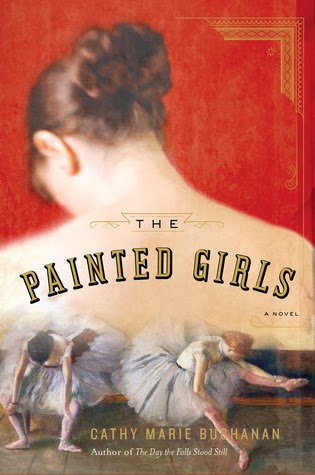
And then I was gifted The Painted Girls by Cathy Marie Buchanan (Penguin - Riverhead). This is a historical novel about girls--who could be YA if this were pointed in that direction--living in not-quite-fin-de-siecle France. The oldest of three sisters, Antoinette, has lost her place in the ballet, and is pulled toward a fascinating boy who, as she says, makes her feel adored, but may be her ruin. The middle sister, Marie, earns a place in the ballet for herself, as does the youngest, Charlotte, while Antoinette takes a job as an actress. They all work because they love the work, but they also need to support themselves. Their father is deceased, and their mother a laundress who loves laudanum best.
Alternating between Antoinette and Marie, we get a picture of the life of the poor in Paris--the poor who will take second jobs in a bakery before ballet rehearsal, the ones who might take on jobs that involve the sale of their dignity, if it comes to it. Antoinette, prostitution, just enough to save money for the journey to New Caledonia, where her jailed lover will be sent, and where she hopes to join him and to start a new life once he's freed. Marie, to keep the family together, will pose for Degas, who is painting and, in her case, sculpting ballet girls--and when she must, for a patron whose palette is only for show. The space between rock bottom and just above is very narrow, and narrower still once the sisters find that living without one another would be a terrible agony.
What makes this book tick:
1. Lots of ballet!
2. And Degas!
3. And it's based on some real people, though not all real relationships.
4. And it's an interesting peek at some of the values of the time.
5. This would make a great book club read.
Undusty new books. Books for everyone. Books with pictures. Books written for kids and teens. Favorites, old and new. Books to buy, borrow, and share. *this blog has moved to www.hallietibbetts.com
Showing posts with label Penguin. Show all posts
Wednesday, February 19, 2014
Friday, December 13, 2013
The Different Girl by Gordon Dahlquist
The Different Girl by Gordon Dahlquist (Penguin - Dutton Juvenile) is one of the most
interesting—and frustrating—books I read this year. Veronika is a girl; she
lives on the island with her three sisters and Irene and Robbert. The girls’
parents died in a plane crash, and now, every day, they learn about learning…in
a way that will tweak the brains of philosophers. They are observed, and they
obey, and they struggle with a new idea: you must obey, but you must also decide.
When May washes up on the shore, after a storm that disrupts
the supply boat schedule, the girls must unravel this mystery: who is the different one? Or are they not different, any of them?
The
Different Girl draws from classic SF in a way that many YA books don’t in that it
brings science and technology to the forefront, and it doesn’t wrap things up
neatly, which is both a feature and a bug.
What makes this book tick:
- Really, really trusts the reader.
- Philosophical questions are embedded here; a good book for that reader who still asks "Why?"
- An open ending (perhaps it’s a series; I prefer this as a standalone) that leaves room for discussion and imagination.
- Asks: what does it mean to be human? What does it mean to be different, and how is that constructed?
Friday, November 8, 2013
Paper Valentine by Brenna Yovanoff
Paper Valentine by Brenna Yovanoff (Penguin - Razorbill) has a sort of
lazy, hot, oppressive feel to it, and not just because the book takes place in
midsummer. Hannah has a friend who’s always hanging around; wherever she goes, Lillian goes too. The thing is, Lillian is dead. And pretty soon, she's not the only dead girl Hannah knows, since there's a killer leaving bloody valentines in the park.
What makes this book tick:
- Excellent imagery
- Believable teenagers
- Murder mystery
- Characters who don’t fit the everyday stock types
Wednesday, November 14, 2012
Born Wicked by Jessica Spotswood
When I try to describe Born Wicked by Jessica Spotswood (Penguin - Putnam Juvenile), I keep saying not quite. Not quite the suppressive teenage marriage/fertility fantasy that's been plaguing the shelves. Not quite the average love triangle. Not quite.
It's about 1900, and the Brotherhood--an organization that one is expected to respect, if not join, if you're male--keeps everyone safe, especially the women. They run the schools and the church. They make sure you get married or join the Sisterhood as soon as you're old enough. And they have...other duties.
Cate and her sisters, Maura and Tess, have managed to stay out of the way of the Brotherhood, mostly. They rattle around in a big old house, emptier since their mother died. When their father goes away and leaves them with a governess, it becomes much harder to hide their terrible, criminal secret: the three sisters are witches. Cate must marry, soon, or go away to join the Sisterhood, but that will split the sisters up, and Cate's not sure that her sisters will be safe without her; a hint or a rumor could have them sent to an institution or a prison ship.
It seems like salvation has arrived in the form of an old friend who's loved Cate for years--but her heart is going in a different direction. Then she discovers that she and her sisters might be part of a prophecy, and that there are many, many witches, some who would use the girls for their own ends. How much will Cate--how much can Cate--sacrifice, and what if all of her options leave someone she cares about heartbroken?
I really enjoyed Born Wicked. I imagine that some readers will see it as particularly feminist, and I don't think that's bad; Cate learns that she most wants to be the one in charge of herself, and that such a situation is good for all people. I just took a quick look around at some other reviews and see that some readers didn't like that aspect so much, and I find that interesting, not to mention a refreshing change from bleak futures where we've reverted to very, very traditional roles with no hope for change.
This book is nominated in the YA SF/F category for the 2012 Cybils. I reviewed a copy that I owned.
Tuesday, November 6, 2012
Bitterblue by Kristin Cashore
I may be one of the last people--well, among fantasy fans, at least--to read Bitterblue by Kristin Cashore (Penguin - Dial). It had been lingering on my shelf since this spring, waiting for me to "have time" to read it uninterrupted. And then, before I knew it, it was Cybils season, and I was working my way down an alphabetical list of 209 books, and I was reading it right now.
Bitterblue is set in the same world as Graceling and Fire, and while one need not have read either in order to enjoy Bitterblue, I think those will help ground readers through the beginning of the story.
Bitterblue, a young queen, is overwhelmed with running the kingdom of Monsea, and she's not getting a lot of help. Instead, her advisors pile on paperwork and discourage her from leaving the castle. Maybe that's for the best; Bitterblue's father, the late King Leck, had powers that he used for evil on many of his subjects. The problem is that the new administration, in forgetting, is ignoring--ignoring the great wrongs of the past, and not truly able to make a future. That's the part where having read the linked books comes in: in the beginning, it's nice to know a little more than Bitterblue does, since she is so muddled, and later on, when the reader and Bitterblue catch up to one another, it's a bonus to understand references to the linked books.
Sheltered Bitterblue is curious, however, and eventually makes her way out of the castle to hear stories. This is one of several lovely literacy themes throughout. The people of Monsea keep their stories alive through the telling, and the stories live on their own, shifting and changing with the tellers. There are themes that are more textual; Bitterblue constructs herself, in a sense, through what she reads. And, ultimately, forms of writing are very important to the story.
There is romance, and adventure, and fighting, which one probably expects from Kristin Cashore, and Bitterblue has an especially complicated story full of puzzles, something new for this book. It's fiendishly plotted, and it might take more than one read to find and appreciate all of the hidden clues. Bitterblue is a fitting culmination of the Graceling series.
This book is nominated in the YA SF/F category for the 2012 Cybils. I reviewed a copy that I owned.
Monday, August 13, 2012
The Bloody Chamber by Angela Carter
Confession: I've been reading, when I can, but I hate Blogger's new interface so much that I've been avoiding it. Bah.
I read Angela Carter's classic collection of stories, The Bloody Chamber, as general research for Sirens, this year focusing on retellings. There are a couple of papers being presented this year that focus on or reference the book, and we considered it for a time for our book-club-like Books and Breakfast program (but ultimately chose not to include it, thinking to include some less-familiar retellings and to make room to highlight more different bookstore age levels, approaches, cultures, and so on).
If Disney's princesses are the shiniest and most spotless, The Bloody Chamber is the grungiest, finding the horrible hearts of the tales that include, among others, Bluebeard, Snow White, Beauty and the Beast, and Little Red Riding Hood, as well as a take on vampires and a story about the Erl-King, with whom I'm most familiar via lieder. A few of the stories seem rustic, rural, in the way many fairy tales are, but others, like "The Bloody Chamber," have a glamorous, Gatsbyish feel, and I liked those best. Probably no surprise!
Even starting to analyze a single one of the stories would take more than a blog post, but I will mention that it's especially interesting to me that this collection has been adapted--retold--in film and music. And I think that's due to its grotesque charm; you are the fly, and the flytrap, with its awful smell, will eat you.
I read the Penguin paperback edition.
Tuesday, November 1, 2011
Devilish by Maureen Johnson
I can't believe that I hadn't read anything by Maureen Johnson before Devilish (Penguin - Razorbill). This one gets both a fantasy and a science fiction tag, because it's the sort of story that doesn't fit neatly into either bookstore shelf.
Jane's friend Allison is a little, well, bumbly. Jane's been getting her out of scrapes forever, it seems, but one day, just a day after all the girls at their Catholic school witness Allison's mishap (which involves puking), Allison seems to have gotten it together. So together, in fact, that there are mysterious phones and clothes and other nice things. A little investigation and Jane figures out that Allison is sold her soul to the devil, and Jane, like always, will do whatever it takes to help her best friend.
It's a little funny to read this so long after it first came out. I can see shadows of today's YA, a genre that has really exploded in the meantime. One shadow: the book clocks in at about 250 pages. Today, it would be a hundred pages longer. (Maybe not the end of the world, even though I gripe about books that are too long for the stories within; I'd have liked to know more about Jane and Allison's friendship.) Also, I don't want to spoil anything, but there's a romance that presages a certain best-selling paranormal in a fairly funny way.
If you're looking for paranormal with a dose of humor and a dearth of angst, give this a look.
Monday, June 27, 2011
A Countess Below Stairs by Eva Ibbotson
Anna is a countess, and the sort of remarkable person who is kind, strong, and humble, despite a very privileged upbringing. But, when the Bolsheviks do their thing, she and her family must flee to England, losing touch with their servant (who's carrying the non-entendre family jewels). While a family friend has helped younger brother Petyr find a place at a respected boarding school, Anna and her cousin, Prince Sergei, end up in service, Sergei as a driver and Anna as a maid of many different responsibilities.
The Earl of Westholme's household staff are discomfited by the new arrival; they see through Anna's disguise and resent the intrusion on their space--but Anna is careful to fill her new role as one born to do so, and after winning a grudging respect, proceeds to charm the household. At least, all except for Muriel Hardwicke, the earl's common-born fiance, who has some unfortunate feelings about eugenics... But, if the family, the staff, and the Earl turn away Miss Hardwicke, will they have to sell their home and scatter to the winds? And is there any hope for Anna and the Earl's star-crossed love?
The stylized language and Anna's steadfast, grown-up Pollyanna-ish personality make this book loads of fun, though there are moments where information is deliberately held back from readers so the denouement can be fetchingly unraveled all at once. Problems with punctuation and spacing, particularly commas, happen often enough to distract, though not quite often enough to warrant avoiding this book if a sweet romance, not in-period but in a country atmosphere like Pride and Prejudice or Sense and Sensibility, is up your alley. If you have an e-reader, I might recommend an e-version for the fun of quickly and easily looking up rarely-used words and those used in uncommon ways.
Wednesday, June 8, 2011
Who Fears Death by Nnedi Okorafor
Who Fears Death by Nnedi Okorafor (Penguin - DAW), even days after I've finished reading, is one of those books that's difficult to distill, and I have never seen a summary that does justice to how very complex and compelling it is. If you've seen reviews, then you've seen words like genocide, female genital mutilation/circumcision/cutting (worth a websearch to get more information on use of each term, and reasons for and against each), rape, and war. Yet that's simplifying Who Fears Death.
In a futuristic, post-apocalyptic desert, similar to today's southern Sudan, Onyesonwu's Okeke mother is raped by a Nuru man, making her Ewu--visibly, irrevocably different, and outcast from both the Okeke and the Nuru. Onyesonwu, whose name means "who fears death," rebels against the restrictions of her society, and ultimately, decides to rebel against the rules of her world, destroying her father in order to save not just her loved ones, but people who have not loved her. The story, part fantasy, part science fiction, part magical realism, part many other things and Okorafor's original style of storytelling, doesn't shy away from brutal and graphic description, but difficult real-world themes are interwoven with the magical tale seamlessly. Onyesonwu's story is raw, emotional, and nuanced.
It would be easy to highlight a dozen craft elements that I found impressive, such as Okorafor's ability to make me feel like I'm right there, smelling the smells and seeing the sights Onyesonwu does, but I think my favorite is the recurring theme of transformative dying. Several times, a traumatic experience is referred to as a death, while the character lives on, changed, living a new life. I love the idea of the self being reborn throughout life, and death(s) being not endpoints, but waystations, and this theme brings an optimistic, hopeful note to otherwise tragic moments in the characters' lives.
Originally published on the Sirens LiveJournal.
Thursday, March 10, 2011
Incarceron by Catherine Fisher
This review of Incarceron by Catherine Fisher (Penguin - Dial, in the U.S. hardcover) first appeared in the February 2011 Sirens newsletter. I liked this so much that someone got me a copy of Sapphique from the U.K. so I wouldn't have to wait for the U.S. release! As soon as I find some time, I'd love to sit down for a re-read.

Finn lives in Incarceron, a prison conceived as a great utopian experiment, designed so that criminals and scholars could reboot society and create a paradise together. Instead, knowledge and humanity are lost, ailing, self-destructing. Within the prison, which is vast enough to contain isolated settlements and small enough to gather in close around its inhabitants, the question of self-determination--and what it means to be human--looms large as the prison both takes over and shuts down. When Finn finds a strange key with a symbol matching the tattoo on his wrist, and he can hear and see someone inside the key, he starts to believe that he came from Outside, and that maybe an Outside of Incarceron exists. Only one person is ever thought to have escaped from Incarceron, and if Finn is to escape, he'll need help--the prison wants him. Maybe wants him dead.
Claudia is the daughter of the warden of Incarceron prison, and she finds a matching crystal key that can be used to talk to Finn. She's about to marry the prince, Outside, and one day she is to be queen. It's all arranged: Claudia's world is one where it was decided that rules and protocols were the marker of a fine society, and so everyone must play assigned roles in a sort of Faire-esque dystopia. Only the upper classes can find comfort, because they're the only ones who can hide plumbing behind the holographic doors to the chamberpots and the only ones who can sneak a few modern conveniences (like medicines) in around the edges of the law. Even as Claudia discovers more about the world Outside, her thoughts keep returning to Finn, whom she suspects is someone more than the average prisoner--but the mystery of where the prison is, its nature, and who inhabits it could be her own destruction.
There's a lot going on in Incarceron, in a good way, and it's been a long time since I felt a book had just the right number of characters, all of them well-drawn and vivid. Incarceron's story is split fairly evenly between book 1 and its sequel, Sapphique. There's a lot to chew on, from the various plot lines to subtle references to legends that appear as broad stripes. I find it especially interesting that Incarceron draws its heart from science fiction, but makes its points through fantasy. I struggle with comparisons, but I think Incarceron has the beguiling and familiar charm of Harry Potter, where you want to climb in and look around even though you know that's not a good idea; the intensity of The Hunger Games, because these books are pretty relentless; the intricacy of The Golden Compass, with a plot bigger than any single hero/ine; the surreal imagination of Alice in Wonderland; and a sweep as wide The Lord of the Rings, if at the same time claustrophobic in its setting.
For me, the real appeal of Incarceron is the ensemble cast; the sense of danger and adventure; the blend of fantasy and dystopia, and even fantasy as dystopia; the gripping plot; and the twists. If you and I are book friends, then you'll be pleased to know that the sequel to Incarceron, Sapphique, came out in the U.S. last December. Both books are available in the U.K. A film adaptation is in the works.
Claudia is the daughter of the warden of Incarceron prison, and she finds a matching crystal key that can be used to talk to Finn. She's about to marry the prince, Outside, and one day she is to be queen. It's all arranged: Claudia's world is one where it was decided that rules and protocols were the marker of a fine society, and so everyone must play assigned roles in a sort of Faire-esque dystopia. Only the upper classes can find comfort, because they're the only ones who can hide plumbing behind the holographic doors to the chamberpots and the only ones who can sneak a few modern conveniences (like medicines) in around the edges of the law. Even as Claudia discovers more about the world Outside, her thoughts keep returning to Finn, whom she suspects is someone more than the average prisoner--but the mystery of where the prison is, its nature, and who inhabits it could be her own destruction.
There's a lot going on in Incarceron, in a good way, and it's been a long time since I felt a book had just the right number of characters, all of them well-drawn and vivid. Incarceron's story is split fairly evenly between book 1 and its sequel, Sapphique. There's a lot to chew on, from the various plot lines to subtle references to legends that appear as broad stripes. I find it especially interesting that Incarceron draws its heart from science fiction, but makes its points through fantasy. I struggle with comparisons, but I think Incarceron has the beguiling and familiar charm of Harry Potter, where you want to climb in and look around even though you know that's not a good idea; the intensity of The Hunger Games, because these books are pretty relentless; the intricacy of The Golden Compass, with a plot bigger than any single hero/ine; the surreal imagination of Alice in Wonderland; and a sweep as wide The Lord of the Rings, if at the same time claustrophobic in its setting.
Monday, January 31, 2011
The Total Tragedy of a Girl Named Hamlet by Erin Dionne
Eighth grade brings Hamlet into the limelight in ways she didn't expect--two queen bees take a sudden interest in (bothering) her (sister), her ability to read Shakespeare with flair makes her the wonder of the eighth grade Shakespeare project, and someone is leaving cute but mysterious origami pigs for her. All she really wants is freedom from all the scrutiny.
Between parents who are not just involved but come with cloaks, a little sister who knows facts but not how to use them socially (and who's hitting that first horrible, embarrassing awareness of what she doesn't know), and the possibility that those cute notes are a big joke rather than gifts from a secret admirer, Hamlet thinks her life really stinks.
Charming, clever, about growing up and competing with your sister, about attention and how much of it we want, and has the best family fight makeup line ever:
"Honey, open up." Dad's voice came through. "We want to talk to you."Mom's got it right, and if only we were all so thoughtful about what a girl wants. I liked the Shakespeare nods, and appreciated that it wasn't just one more "let's re-tell Shakespeare to give our story some structure" book.
I didn't say anything.
"Please," Mom said. "We want to listen."
Thursday, January 27, 2011
Ombria in Shadow by Patricia McKillip - Read in 2005
Congratulations to Big Pine Lodge-type Debbie: a random number generator tells me that you won my extra copy of Blue by Lou Aronica. Look for an e-mail on how to get it coming your way over the weekend.

A few spare moments this week sent me back to my old blog to work on cleaning it out, and while it was a year in which I listed books I read more than I reviewed them, I did find a review I wrote of Ombria in Shadow by Patricia McKillip (Penguin - Ace). I liked this book, and it grew on me the more I thought about it. It's been a long time since I read this historical court intrigue mixed with fantasy, and I'm going to mark it as adult fantasy, though one I'm sure many YA readers would like.
Even though this book is nothing like the next two I'll name, it reminds me of them. It's like Pullman's His Dark Materials in that the author starts where the story starts--there's no handholding or explaining what is different about this universe. It also reminds me a little of Yann Martel's Life of Pi. And I hesitate to say why if you haven't read that one!
McKillip plays with spatial, temporal, perceptional (okay, I made that word up) and moral ambiguity, but the spatial and temporal are the ones that can make you a bit dizzy. I felt like I wasn't entirely sure what was going on, sometimes, or what had happened, or how.
The writing style of Ombria in Shadow is ornate, but not overwhelmingly so. McKillip uses words in ways people often forget to use them, or uses words that are dusty but still fine, or to uses words suit her own ends. The only thing that made me a little wriggly is that many things are described as being pearls when one of the characters is named Domina Pearl; when I read this last, I couldn't find anything unifying all the references. Handily, that might mean that it's time for a re-read.
Royalty dies, leaving behind his mistress and a son; Domina Pearl, ageless and sort-of evil...person holds the fate of the kingdom in her hands; Ducon Greve can see across this and a shadow world; and Mag, of unknown origin, has a foot in both. The complicated plot could easily have held romance or even erotica, and that's where many stories would go, but instead, the characters' lives intersect along the way to the kingdom's final fate and the relationships--self-history, mother-daughter, allies-foes--are far more compelling and complicated for their tight focus.
Tuesday, October 19, 2010
The Eternal Ones by Kirstin Miller
So let's get the bits I wasn't fond of out of the way first: the romantic interest pushed some buttons for me, and not good ones. Because we're in the heroine's head, we don't know what he's thinking (which is, admittedly, important to the plot), and his interference and romantic aggression bothered me in a way reminiscent of the relationship between Bella and Edward in Twilight. At the same time, the heroine has, and knows she has, the ability to remove herself from the situation for most of the story (with a few notable exceptions, and at least one is important for plot reasons), and she has considerable agency over her participation in romantic liaisons.
But let me back up, because this was an enjoyable read. Haven Moore lives in a small, conservative town, where her visions of a past life in 1920s New York City are thought to be the work of the devil. Her best friend, Beau, helps her make beautiful dresses for her fellow students, which is the only thing that keeps her from being a total outcast--until she destroys her pastor's office during a vision. Haven's strict grandmother wants to lock her up, and her grieving mother is afraid to protect her. Only Lizzie, whose Pentecostal faith gives her a different view on Haven's visions, and Beau, her staunch supporter, are there for her, but all of her dreams and sudden lapses of consciousness are for someone named Ethan that she's been talking about since she was a little girl.
Haven goes to New York to find the Ouroborous Society, thinking that their work in reincarnation may provide her with some answers. She also goes to track down Iain Morrow, a star who knows her instantly, and whose memories match hers of being Constance and Ethan in years past. He whisks her away to Rome in a whirlwind of romance and fun, but people are following them, and it's not just paparazzi. Iain keeps disappearing, and the DA has questions about the death of his friend. Maybe he's seeing that artist whose whereabouts are unknown, or the president of the Ouroborous Society, who wants Iain to keep up his duties to the secretive order. Haven doesn't know whom to trust: her head and her heart don't agree at all. She's had a tragic death as far back as she can remember. Can she survive this life, or will she keep repeating her past?
The Eternal Ones draws heavily on the romance genre, and the mix of fantasy and reality is one that many paranormal romance books could aspire to. The main character could very well have been aged up a few years, and this story published for adults. I think it's important to point out that many teenagers read adult romances, and that it's a function of the YA category that several scenes to fade to black, leaving the rest to imagination. I mused a little bit on romance on this blog recently, and we have a new contender for romance-as-romance; with her past lives, Haven needs to solve a mystery more than she needs to experience personal growth.
The first section of the story, before Haven goes to New York to meet Iain, fits my definition of the "B story" in some ways, in that it's about the main character, but not directly related to the main question ("Is Iain trying to kiss me or kill me?"). Typically, the B story gets mired down when it's introduced and focused on heavily in the first fifty pages, and serves to put off addressing the main question--and, sadly, to pad the book's word count. In The Eternal Ones, it's (in my copy) 134 pages before Haven leaves town, but the first third of the book is well-spent in exploring the religious themes of the book, which tie into the middle and end. Usually, the B story just kills time until the real story starts, if the author isn't able to weave it into the whole arc. Here, I found it to be a little longer than necessary, but worthwhile for the way it sets up the tension between faith and those trading on others' faith for their own ends.
I read this book as a first-round judge for the Cybils Awards, which means that I may have received a review copy from the publisher (or not; I own a lot of the books in this category). I read some books nominated for the YA fantasy and science fiction category in 2010 before the nomination period, and may have already reviewed them or declined to make a public review; these books might not have a Cybils post tag. As a first-round judge, I was tasked with helping create a shortlist of books. My personal reviews do not reflect any actions or discussions of the judging committee.
Tuesday, September 14, 2010
The Faery Reel, edited by Terri Windling and Ellen Datlow (read in 2005)
This collection of new faery tales is like having a selection from the various-colored fairy tale books from Andrew Lang--without the obnoxious and dated forewords. There are 500-odd pages of stories and poems. Some of the best stories, in my memory, are the ones by Katherine Vaz and Holly Black, as well as one that's all about Tinkerbell without any of the cutesiness of Disney. My very favorite, and in fact, one of my favorite short stories, hands down, is Kelly Link's "The Faery Handbag," about a handbag that's the portal to faery, which is bittersweet and sad without telling you if should really feel that way. There's also a source list at the end for stuff written in the last 25 years or so, which might make a good starting point for other people interested in exploring faery/fairy tales further.
Friday, May 28, 2010
The Ear, the Eye, and the Arm
The Ear, the Eye, and the Arm by Nancy Farmer (Penguin - Firebird) is set in a futuristic Zimbabwe where Tendai, Rita, and Kuda are kept safe from gangs in their parents' house--at least, until they escape for a little adventure. Once on the outside, the children are kidnapped and sent to the plastic mines, giving you just a hint of the tension between technology and the natural world of the story. Three detectives--the Ear, Eye, and Arm of the title--are enlisted to find them, but can they do it when the kids don't exactly want the adventure to end? At least, not before they figure out that their lives are in danger...
This is one of those books that I find pretty hard to review, and pretty hard to sell to friends. But here's a quote from the teen heroine: Tendai was reading Sun Tzu's Art of War, and Rita had the writings of Julius Caesar. "Who cares how the Romans built their roads?" she grumbled. "They should have all stayed home and had orgies." That's not a line you'd see in too many young adult books, you have to admit--and though it's not representative of the plot, it's a hint that this book won't be quite what you expected.
I really enjoy this story, and I think it's one of Nancy Farmer's best, inspired by the many years she lived in Africa. One thing that I think makes this a difficult book to get others to pick up is the cover art; while I don't have a recommendation, necessarily, I don't think that any of the covers for this Newbery Honor have been able to reflect the adventure within. Some, I think, focus too much on the adults and not enough on the teens for this type of book. The bottom left is my least favorite, and I think the least appealing; I own the one on the bottom right; the top left might make me think it was published well before the mid-90s; I think I like the top right best, but I wish it balanced the mask with the hint of the science fiction setting a little more. Here's a sampling.


Wednesday, April 15, 2009
The Blue Girl - Charles de Lint (Read in 2004)
Subscribe to:
Posts (Atom)


