Tuesday, March 25, 2014

Up in the Air by Walter Kirn

I've never seen the film of Up in the Air by Walter Kirin (various editions; I read the movie tie-in). I understand that few of the plot points are the same, so if you've only seen it, well, I'm interested in hearing what you think.

Ryan Bingham speaks corporate. He's a road warrior, position head-remover. When a company needs people fired, Ryan does it, and counsels them toward Believing in Themselves and Succeeding. He thinks MythTech might be going to swoop in and save him from this bilious sort of life. They're checking up on him, aren't they? Sending him secret messages, aren't they? We stay with Ryan for his last itinerary, during which he's trying to hit his million airline miles before he quits. He'll give some away to charity and take a trip. It'll be nice.

Before he leaves, Ryan leaves his resignation on his boss's desk. He tries to make his meetings while also pitching a book deal, having some hookups, and retrieving his sister, a runaway bride, before heading to the family homestead. It's all a bit bizarre.

For me, the jaded businessman was an okay story, but the more fun one was spotting the outdated tech (this was published just after Y2K). Executives worrying about cell phone minutes. Metal detectors only at airport security. Cassette tape players (already a little old then). And yet, because Ryan was really interested in his own security and how he was being watched by MythTech, there was something creepily futuristic (modern?) in his fear.

I confess I felt a bit cheated by the ending, but I also should have seen it coming, and it does leave the book open for re-reading and reinterpretation. I won't, but someone else might. Instead, I'll revisit some of the travel books I used to sneak read in my youth, like the infamous Coffee, Tea or Me?

That's the end of the adult book winter reading stretch; next, it's back to YA. I'm working on a contemporary shelf that I'm trying to box up, so it'll be a bit before I'm back to SF/F.

Tuesday, March 18, 2014

The Valley of Amazement by Amy Tan

You know, when I stumbled past Amy Tan being interviewed at last year's Book Expo America, I had to stop and listen, even though that's not what was on my itinerary. She's just an interesting lady! I put The Valley of Amazement (HarperCollins - Ecco) on my to-read list, and received a copy for Christmas, and since it's (for me) catching up on things not YA/fantasy/SF season, I grabbed the book out of the vast pile that I'm trying to pare down. (Books are going in boxes for a variety of reasons, and I won't see them again for a while.) I noted that I haven't read anything of Tan's in a while, but I think I thought I had because The Joy Luck Club is so often excerpted for tests and reading curricula.

Anyway.

This is a commitment of a book. It's quite long, and it's quite harrowing. Lulu Minturn runs a brothel in Shanghai in 1905, one where locals and foreigners can meet to mingle and do business as well as do business. Her daughter, Violet, is absolutely American until she realizes she isn't, and that her father is Chinese. The Qing dynasty comes to an end, and the plan to go to the United States, but one of Lulu's paramours tricks Lulu into leaving Violet for dead, and the paramour sells Violet to another brothel. There, she must be perfectly Chinese to survive.

There are a lot of themes I like in this book. One is long-term friendships between women; another is the love (and sometimes difficulty) of navigating relationships among several generations of women in the same family who have grown up under very different sets of rules. Another is recognizing, appreciating, and enjoying love--and understanding what love is not. Yet another is forgiveness. And another resilience. Another navigating being part of two very separate backgrounds.

I enjoyed the historical setting, largely because there's a focus on the everyday--what people ate, thought, wore. (I am not familiar enough to speak to its accuracy; I assume that some details are brutally honest, some changed to support the story.) I liked that the women here are complex--sometimes sympathetic, sometimes unlikeable, sometimes making choices or holding attitudes I think they shouldn't. I liked that the brothels aren't allowed to be too nice, even when we're nice; just when you think Violet is safe, we're reminded that even though this is fiction, it's based on a harsh reality. (It's too easy to be enchanted by the surface details of beauty and art and forget that the end result is sex for money with girls, and when they fall from grace, the rest of their lives can be short and violent. Details are not held back.) I thought that Violet's pull to be parts of two worlds and two races was interestingly mutable as she incorporated outside influences with her own feelings (and her observations and decisions are much more thoughtful than those of others, who want to simplify her at every turn).

It seemed to me that some spots in the book, particularly lengthy character monologues, replaced even lengthier sections that had had to be cut. I understand that Tan spent a lot of time with family and guides researching The Valley of Amazement, so she probably had more material than could be incorporated, and I sometimes wished for more polishing of those bits. However, everything else flew by, and I really was engaged by Violet and the other women who get a bit of narrator time. I'd recommend this for fans of Memoirs of a Geisha and Snow Flower and the Secret Fan, as well as for readers who like imperfect family relationships, sweeping historical stories, and friendships.

Wednesday, February 19, 2014

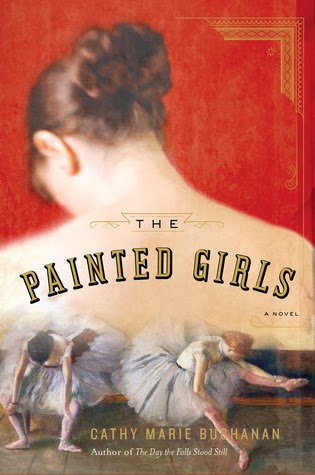
The Painted Girls by Cathy Marie Buchanan

At the beginning of the year, I tend to catch up on my "adult" reading--Smithsonian and National Geographic, nonfiction, business and craft books, and the like. I'm currently reading Hothouse and I just finished and was wowed by Jumped by Rita Williams Garcia (not an adult book, but in one of the to-read piles that was easier to read than to box up, since I'm packing books at the moment).

And then I was gifted The Painted Girls by Cathy Marie Buchanan (Penguin - Riverhead). This is a historical novel about girls--who could be YA if this were pointed in that direction--living in not-quite-fin-de-siecle France. The oldest of three sisters, Antoinette, has lost her place in the ballet, and is pulled toward a fascinating boy who, as she says, makes her feel adored, but may be her ruin. The middle sister, Marie, earns a place in the ballet for herself, as does the youngest, Charlotte, while Antoinette takes a job as an actress. They all work because they love the work, but they also need to support themselves. Their father is deceased, and their mother a laundress who loves laudanum best.

Alternating between Antoinette and Marie, we get a picture of the life of the poor in Paris--the poor who will take second jobs in a bakery before ballet rehearsal, the ones who might take on jobs that involve the sale of their dignity, if it comes to it. Antoinette, prostitution, just enough to save money for the journey to New Caledonia, where her jailed lover will be sent, and where she hopes to join him and to start a new life once he's freed. Marie, to keep the family together, will pose for Degas, who is painting and, in her case, sculpting ballet girls--and when she must, for a patron whose palette is only for show. The space between rock bottom and just above is very narrow, and narrower still once the sisters find that living without one another would be a terrible agony.

What makes this book tick:
1. Lots of ballet!
2. And Degas!
3. And it's based on some real people, though not all real relationships.
4. And it's an interesting peek at some of the values of the time.
5. This would make a great book club read.

Friday, December 13, 2013

The Different Girl by Gordon Dahlquist


The Different Girl by Gordon Dahlquist (Penguin - Dutton Juvenile) is one of the most interesting—and frustrating—books I read this year. Veronika is a girl; she lives on the island with her three sisters and Irene and Robbert. The girls’ parents died in a plane crash, and now, every day, they learn about learning…in a way that will tweak the brains of philosophers. They are observed, and they obey, and they struggle with a new idea: you must obey, but you must also decide.

When May washes up on the shore, after a storm that disrupts the supply boat schedule, the girls must unravel this mystery: who is the different one? Or are they not different, any of them?

The Different Girl draws from classic SF in a way that many YA books don’t in that it brings science and technology to the forefront, and it doesn’t wrap things up neatly, which is both a feature and a bug.

What makes this book tick:
   

  1. Really, really trusts the reader. 
  2.  Philosophical questions are embedded here; a good book for that reader who still asks "Why?"
  3. An open ending (perhaps it’s a series; I prefer this as a standalone) that leaves room for discussion and imagination.
  4.  Asks: what does it mean to be human? What does it mean to be different, and how is that constructed?

Monday, December 9, 2013

Dark Triumph by Robin LaFevers

Sybelle, assassin of the convent of St. Mortain, is Death's daughter--but she's also the daughter of d'Albret, who would kill you if the shadows on your face hinted of your disloyalty. Or maybe just because. In the war for Brittany to remain separate from France in the late 1400s, the convent takes the side of Brittany, and sends forth its assassins, including Sybelle, to murder those who are marqued for death.

Sybelle, however, is not easily led. She struggles with the rules of the game; she's not nearly the pawn others would have her be. When she has to flee with a mysterious knight who's been held in a secret dungeon, her mask is torn away, and she must fight openly. And somehow, she must be willing to face Death and all its attractions head on.

What makes this book tick:
1. Sybelle, Katsa, and Katniss deserve a quiet retreat together....
2. Subtle meditation on identity and faith wrapped up in a violent war setting.
3. Romance that does not require the heroine to take a back seat.

Thursday, December 5, 2013

When We Wake by Karen Healey

When We Wake by Karen Healey (Little, Brown - Books for Young Readers) starts off in the not-so distant future--and in Melbourne, one of my very favorite cities. Tegan is your average teenager (without that awful "normal" boringness that sometimes pops up before stories take off). She's going to a protest with her friends, and she's in her first breath of love, and she's got a lot of life left to live. The next thing she remembers is waking up...a hundred years later. It's not as simple as taking the next breath; Tegan has to decide what to do in the world she has to inhabit.

What makes this book tick:
1. Dystopian elements extrapolated from modern-day Australian and other politics
2. Science and psychology
3. Rebellion!
4. Inventive story frame

Monday, December 2, 2013

All Our Yesterdays by Cristin Terrill

All Our Yesterdays by Cristin Terrill (Disney - Hyperion) wasn't in my most-urgent reading pile for the Cybils. The cover, while nicely done, fits the mold of a dozen other orange-blue "adventures" I've seen lately. But I thought I'd share this as an example of how all nominated books are being viewed and reviewed by the first round judges--it's great to open to the first pages and be surprised! After a bit of a mysterious start, the action is non-stop.

Em is imprisoned. What she knows is that she dreads the drain, and that Finn, on the other side of the vent, is her whole world, the only person she can talk to. Then, one day, she steals a spoon and opens the drain, and finds a letter, to her--from her. And there's one instruction: kill him.

What makes this book tick:

1. Time travel!
2. Nonlinear storytelling.
3. Questions about fate versus free will.

Related Posts with Thumbnails